
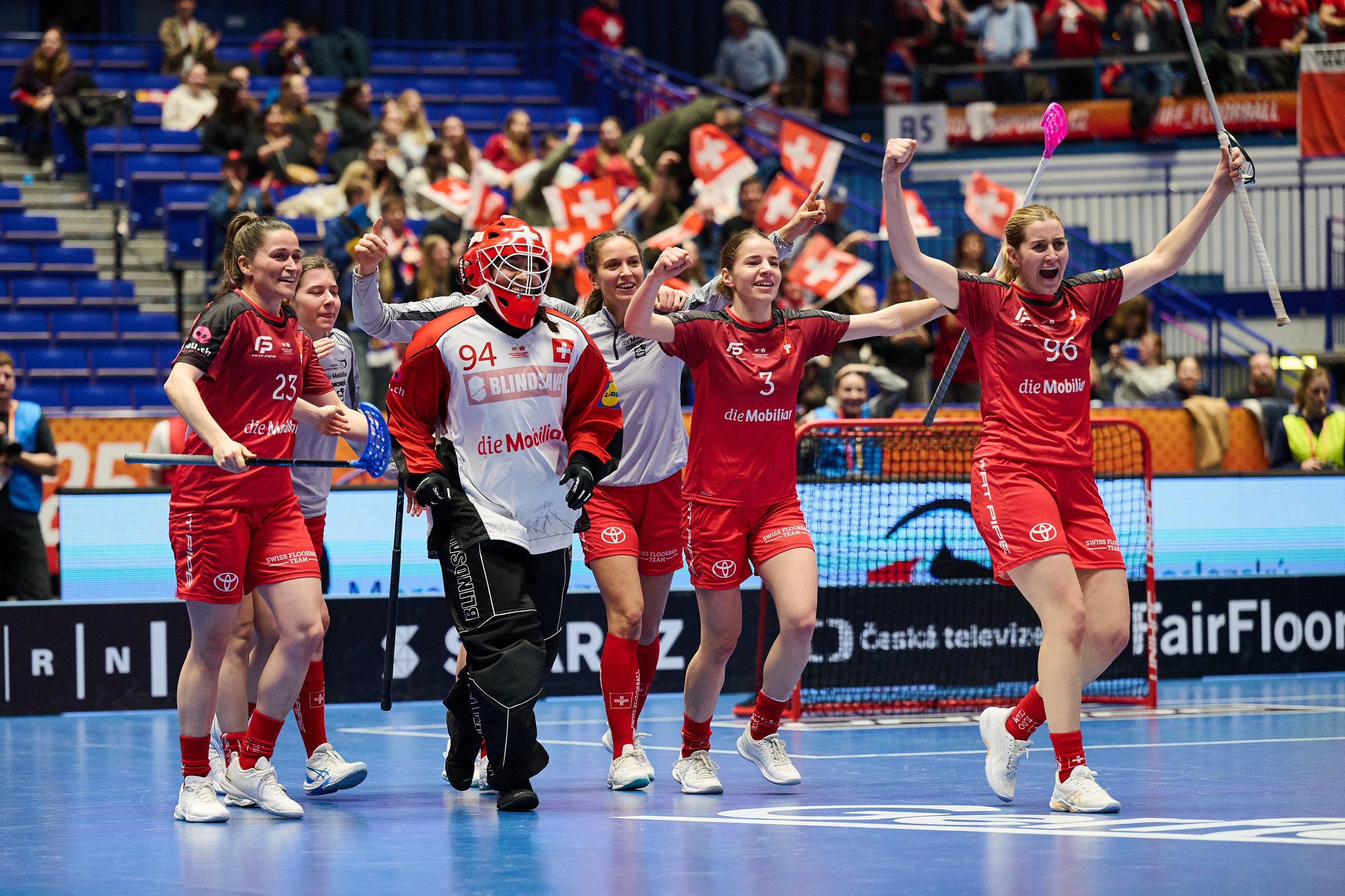
For sports fans who don’t follow floorball in great detail, the hierarchy has long seemed simple: gold is always contested by one of the Nordic teams, while the rest try to catch up. That convention, however, has been broken by the Women’s World Floorball Championships final in Brno and Ostrava, where — for the first time in history — Czechia and Switzerland will meet in the battle for the title. Let’s take a closer look at this exceptional matchup.
Let’s start with the numbers
The two teams will play their 72nd head-to-head match. The historical balance still clearly favours the team from the land of the Helvetic cross: Switzerland have won 45 matches in regulation time, another four in overtime, while five games ended in draws. Czechia have celebrated victory just 17 times, three of those in extra time.
A lot of time has passed since their very first meeting on 1 March 1996, which the Czech Lionesses won 2–1 — only to then wait six long years for their next triumph. In recent years, however, clashes between these teams have been anything but predictable.
Since 2021, when international floorball returned after the COVID hiatus, Czechia and Switzerland have played 15 matches. The balance? Eight wins in regulation, one in overtime, and six defeats for Czechia. The goal difference of 65:56 further underlines how close these encounters have been.
What remains particularly significant is that during this period, the two teams met three times in medal games — and each time, the details decided the outcome. Switzerland came out on top in the bronze medal matches at the 2021 championships in Uppsala (5–2) and at this summer’s World Games in China (4–3). Czechia finally broke their curse in 2023, winning bronze in Singapore after a thrilling 5–4 victory.
The tenth medal clash
Fourteen times — that’s how often Czechia and Switzerland have met at major events (World Floorball Championships and now also the World Games). Only four of those encounters ended in Czech victories. Just five of the matches took place in the group stage; the remaining nine directly decided medals.
Twice, Switzerland’s victories meant silver medals — in 2009 in Västerås and ten years later in Neuchâtel, both times after semi-final wins. Swiss players have celebrated five bronze medals (four at the championships and one at the World Games), while Czechia were happier just twice.
That makes Sunday’s final all the more symbolic: the two teams will face each other for a medal for the tenth consecutive time since 2009, when Czechia first broke into the world’s top four.
Looking specifically at the Women’s World Floorball Championships, the teams last met on Monday in Brno, where Czechia claimed a 7–4 win. It is also the third time that Czechia and Switzerland will replay a group-stage matchup later in the same tournament. This first happened in 2013, when Switzerland won both encounters, and again in 2021 in Uppsala, where a Czech 5–2 group-stage win was followed by Swiss revenge in the bronze medal match.
A new flavour — and the Chur preview
This match, however, is different. For the first time ever, the two teams will play directly for the world championship title — something that has never happened at any age category. Until now, either Czechia or Switzerland always had to face Finland or Sweden in the final.
Czechia wrote history in the semi-finals by becoming the first team ever to shut out Finland at the championships. Switzerland, meanwhile, ended Sweden’s 18-year unbeaten streak at the Women’s World Floorball Championships.
A shock? Absolutely — but not entirely unexpected. Aside from the opening Euro Floorball Tour tournament in Karlovy Vary, where Sweden dominated, the entire cycle featured extremely balanced competitions.
Most notably the final EFT in Chur. Switzerland defeated Sweden there, and Czechia overcame Finland, who also fell to the hosts and lost the Nordic derby as well. The final between this year’s championship finalists had to be decided by a shootout — one won by Lukáš Procházka’s team.
Two teams, one shared story
The World Floorball Championships in Singapore marked the end of two great eras. Switzerland said goodbye to their icon and record-holder Corin Rüttimann, while Czechia lost their own legend, record-holder and icon Eliška Krupnová.
New leaders took over the captaincy — and handled the responsibility superbly. Both teams now rely on strong goaltending units, consistent production across all three lines, and excellent internal chemistry. Fan support has also been a major strength on both sides.
At the start of the cycle, few believed either team could succeed in such a convincing way. Yet both prepared perfectly for the most important tournament. From the quarter-finals onward, they played with focus — and, crucially, never abandoned their active style of play.
Neither reached the final through defensive lock-downs or lucky bounces, but through precise, confident performances, showing no unnecessary respect for their favoured opponents. One notable difference does remain: finishing. Czechia could easily have won by a wider margin. The goal frame saved Finland twice, and bad luck struck the Czech captain in the shootout when the ball slipped off her blade. The posts rang on both sides in the Switzerland–Sweden semi-final as well. And while history will one day remember only the results, the way both teams reached the final should not be forgotten.
A defining moment for floorball as a whole?
Without question. And a clear message that this sport is no longer just about Sweden and Finland. Yes, the gap between the top four and the rest of the field at the Women’s World Floorball Championships remains significant — as the predictable quarter-final results showed — but the semi-finals in OSTRAVAR ARENA proved that within the elite four, truly fascinating things can happen.
Who knows — perhaps this very success will become the motivation teams need to believe they too can one day challenge for medals.
We don’t have to look far for an example. Czech women waited until 2011 for their first medal. Even though the next one came twelve years later, wasn’t that first podium finish enough to show young girls that it is possible? That the dream medal can be reached — not only by them, but by everyone involved in their development.
Fourteen years after that first bronze, the courts of STAREZ ARENA VODOVA and OSTRAVAR ARENA are now home to a generation of players who regularly collected junior medals and are doing so at senior level as well. A generation that took its first floorball steps around that time.
And even if that moment didn’t influence them directly, it surely motivated others to help create the environment in which these fighters were born — players who are now rewriting history and inspiring even more girls to fall in love with floorball.