The IFF introduces a new “7-Event Structure” to elevate the sport. The goal? To ensure every game matters, guarantee annual major events, and open the door for new organisers.
The world of floorball has changed dramatically since our current competition system was established in 2005. Floorball family has more than doubled the number of federations, the sport has grown, players are faster, and our global reach is wider. However, our calendar hasn’t kept pace. We have seen too many qualification matches ending with big score differences—results that benefit neither team and certainly not the image of our sport.
It was no longer a question of if we should change the system, but how. The previous model had simply stopped working effectively for our federations at all levels—from top nations seeking elite competition to developing countries needing realistic pathways, said Filip Suman, President of the IFF.
We had to build a structure that actually serves the diverse needs of our global family. The information package clearly illustrates the depth of this 7-event structure, and I encourage everyone to explore it deeply. I would like to thank all the federations and their representatives who helped shape this major transformation. I firmly believe there is true potential within this new structure for the future growth of our sport.
After almost two years of dialogue with our National Associations, the IFF is proud to announce a transformation: The 7-Event Structure.
1. Making Every Game Matter
The most significant change is the shift from a 2-year cycle to a 4-year cycle. We are abolishing old qualification tournaments. In the new system, when a national team travels, they are playing for a title, a medal, or a trophy.
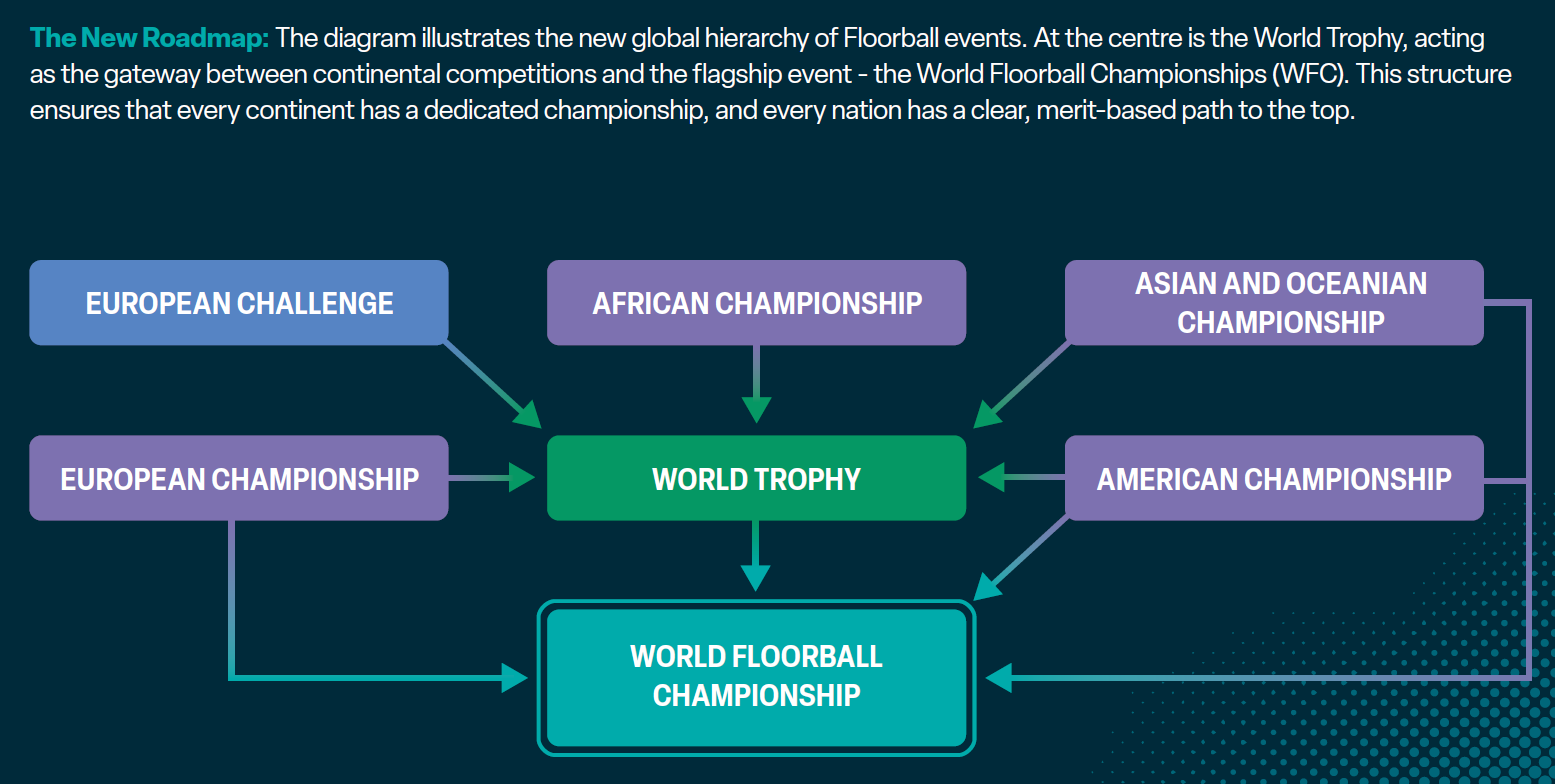
- Continental Championships: Instead of qualifiers, teams will fight for prestigious regional titles in Europe, Asia-Oceania, the Americas, and Africa.
- Continental Challenge: Event for the countries which do not get a chance to play the Championships. They can play a great tournament with a chance of winning and finding their way to the WFC. It starts in Europe but gradually can be launched also in Asia–Oceania.
- The World Trophy: A brand-new world-level event designed to break the “glass ceiling” for developing nations. It offers a chance to win a global title against realistic opponents and serves as a pathway to the World Floorball Championships (WFC).
2. A Consistent “Heartbeat” for Fans
The new calendar guarantees a Major Event every single year. By alternating between Men’s and Women’s events, we ensure a constant spotlight on the sport. Furthermore, we are extending these major events to 11-12 days, creating a longer, more immersive window for media and fans in the prime slot of mid-November.
3. Sustainable Hosting Opportunities
We are also changing how we organise events. The new Co-Hosting Model allows two or possibly even more countries to share the hosting duties. This reduces the financial risk and logistical burden for organisers while doubling the potential for home crowds, government/city support and local sponsors. It opens the door for more nations to host major IFF events and get the advantage from hosting the events. For fans it means closer events, bigger chance to see the stars and enjoy the atmosphere.
This is a very exciting change to our international calendar and our whole international event structure. I believe that the 7-Event Structure will give new opportunities to our Member Associations, allowing them not only the possibility of participating in new competitions, but also allowing them the space and time to develop and grow internally. Importantly, it is an event structure that we have purposely designed to be able to adapt in the future to accommodate our ever-growing international Floorball family, said Sarah Mitchell, Event Manager of the IFF.
Timeline: When Does It Start?
It is important to note that this is a long-term strategic shift.
- The current calendar remains valid through 2028.
- The transition begins in 2029 with potential European Challenge in 2028.
- This gives all National Associations ample time to adjust their planning and budgets.
Full explanation of the changes including the details of the structure and the FAQ can be found in a PDF file here.
FAQ
STRUCTURE & CALENDAR
When will the new event model officially start?
2028 for women and 2029 for men. The Women’s WFC 2027 will be the last in the 2-year cycle, and the European Challenge in 2028 will be the first event in the new structure. For the men, WFC 2028 will be the last, with the European Challenge in 2029 being the first of the new events.
Will only playing the WFC 4-years have impact on the visibility of Floorball in the media?
No. The new structure guarantees a major IFF international event every year, alternating between Men and Women. The new events (European & Continental Championships and World Trophy) will present new media opportunities, and the extended duration of major events (12 days) creates a longer media attention window for Floorball. We expect that the European championships will create the same attention and visibility as the current WFC.
How is it possible to ensure that the European Championships carry the same weight and interest as the current WFC?
The European Championship will essentially be a “Best of the Best” tournament. Since the top European nations currently dominate the world rankings, the sporting level will be identical to, or even higher than, the current WFC group A & B stages. Furthermore, by using the co-hosting model with two organisers, we will create a massive event atmosphere with two home crowds and doubled marketing reach.
Why is the major event (WFC/Euro) moving to mid-November?
This decision supports our goal to maximize media visibility. Based on our analysis and the successful test during the WFC 2022, November offers a unique “media window.” It allows us to avoid direct clashes with major summer sport events or the flow of the winter sports season. The national leagues can profit from a November event, allowing for continuation of the leagues after the WFC still before the Christmas. Detail analysis of this topic is available.
Which specific months or calendar windows are absolutely protected for national league competition under the new calendar?
The new structure was designed to minimise disruption to national league calendars and allow for season extension. The major events are scheduled in mid-November, and IFF events are no longer scheduled for May. The goal is to provide clear, protected windows for domestic competitions, but the final, detailed international weekend calendar (2029 onwards) is still being finalised and will be published during 2026.
What happens to the other IFF events, such as the Champions Cup or EuroFloorball Cup, under the new 4-year cycle?
The 7-Event Structure focuses on the national team pathway. Decisions regarding future IFF club competitions will be addressed after the successful presentation of the new National Team Structure. Since Club competitions are very important, there is a detailed discussion planned with European federations about the structure of the Champions Cup and its connection to other club competition levels.
The U19 WFC moves to February. How does this impact the availability of players who are still in school or have club obligations in the start of the year?
This move is highly beneficial. Moving the U19 WFC to February protects the players’ educational commitments and frees up May for leagues to extend their domestic seasons. Finding a better time period for the U19 WFC was a key part of the new calendar design.
COMPETITIVE PATHWAYS & RANKING
How will rankings and quotas now be calculated?
A new ranking system and regional quota system are being created. This system is being designed to accurately reflect competitive performance across the 4-year cycle, including major events as well as other international matches, ensuring that each international game gets extra value. Information on this will be published during 2026.
Why does Africa not have any teams directly qualified for the WFC?
The African National Associations are still in a development stage and are not yet playing regular fullcourt competitions, with the African Cup being played as a 3v3 or 4v4 event. Direct WFC qualification will be reviewed once they reach the 5v5 system, meet license requirements, and show a competitive level in the World Trophy event.
The new system can mean that smaller / developing nations will practically never get games against the strongest teams in the world. Will this negatively impact development of the countries?
For smaller nations, the structure aims to ensure more games against teams of a similar, or slightly above level, which is far more effective for accelerating growth than being consistently beaten by big numbers. The Continental Championships and Challenge event will create the environment for these more competitive matches. The World Trophy provides the highest level exposure to new multicontinental opponents.
How will qualification to The World Games be decided? When will it be played?
It is most likely that the WFC events prior to the The World Games will act as the main qualification event, or in some cases there may be regional qualifications. The system of qualification is still to be confirmed.
FINANCE, ORGANISATION & LOGISTICS
What will be the difference in total registration fees paid by the federation over 4 years compared to the existing system?
The IFF is aiming for cost neutrality during the cycle 2029-2032 plus potential small valorisation, but the cost structure for participation and registration fees is still being finalised. The exact financial model will be published during 2026.
Will there be any support/subsidy system for teams which qualify from the World Trophy to WFC, meaning they play 3 events during the 4-year cycle?
Yes, The IFF is considering a support model for teams that would participate in a continental event, World Trophy, and WFC, especially if this involves intercontinental travel for more than one event. The detailed system will be part of the final regulations.
What specific cost savings does the single-arena model (2-hosts) bring to organisers?
The co-hosting model requires each organiser to manage only one arena, which means much lower costs and easier logistics. This structure also allows for double government support and double local sponsorship, and more games with a home audience, making the event financially attractive.
How will the two-host system for events work, and what specific support or mechanism is in place to pair a smaller, developing nation with an experienced organiser for cohosting? The co-hosting model allows a developing floorball nation to partner with an experienced organiser. The smaller nation gains know-how and infrastructure without carrying the full risk. Potential partnerships of more experienced organizers would be also possible. The specific mechanism for leveraging these partnerships will be detailed in the final regulations in 2026.
Will there still be a possibility to apply for hosting a major event as single organiser? Technically yes, but the advantage of more organisers brings such big financial benefits that it will be di-cult to compete with that.
REGULATIONS & FUTURE ADAPTABILITY
When will the Organiser Regulations for the new events, including the changed WFC system, be ready and approved?
The Organiser and Competition Regulations for all new events are being prepared and will be published during 2026.
Will the organiser requirements for hosting events change?
There will be changes to organiser requirements, as each event tier will have different regulations and a different level of services required.
Why is the WFC system different for Women (16 teams) and Men (20 teams)?
To offer equal opportunities for both genders does not mean providing exactly same system. There are fewer women national teams registering for the IFF event and having the same structure would not benefit the women’s competition. As the number of participating countries grows, then the system is ready to adapt to those changes.