
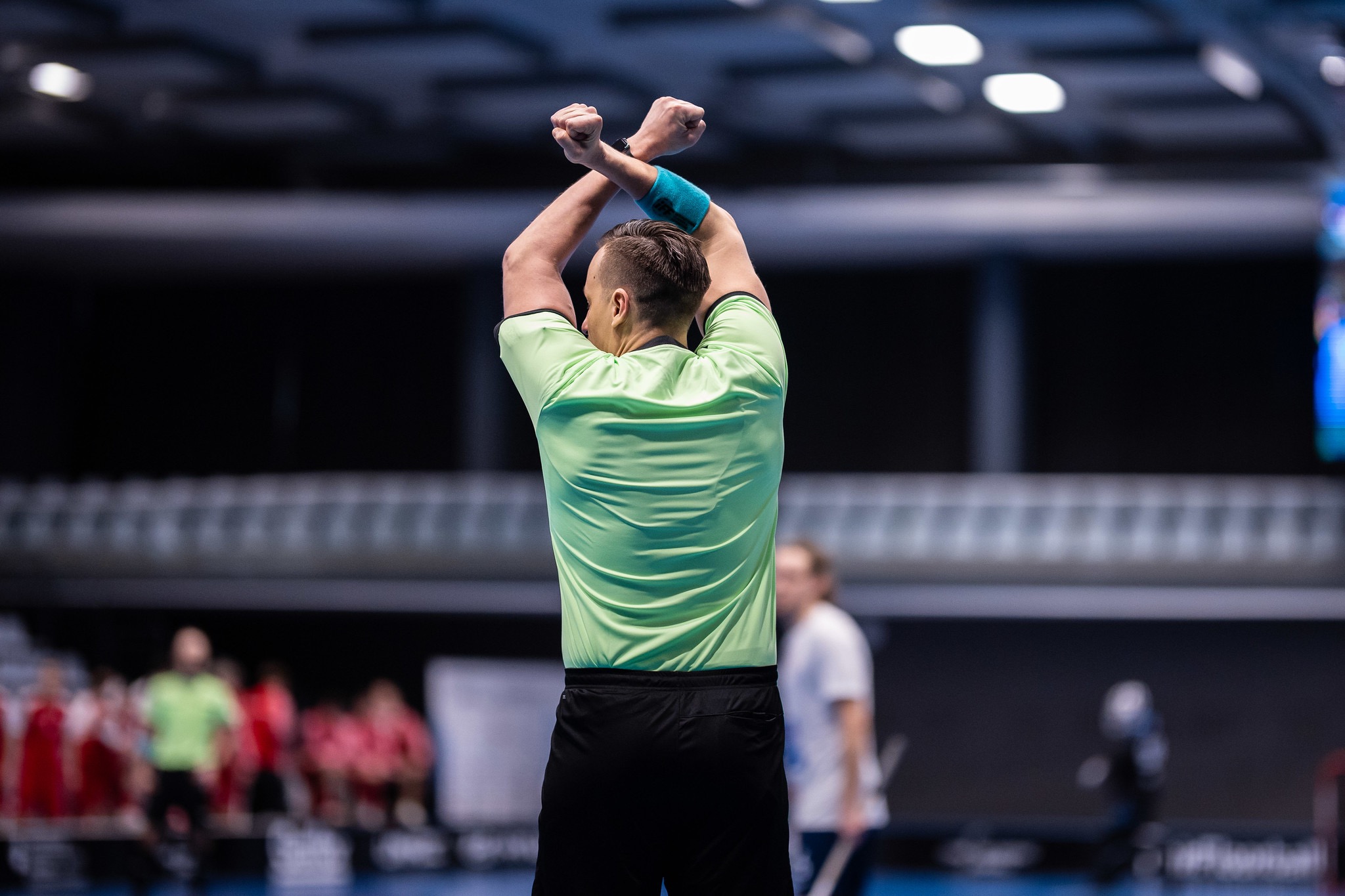
The next edition of the Rules of the Game, valid from 1 July 2026, is ready to be distributed to the floorball world.
Floorball is a global and rapidly developing sport, and it is essential that the Rules keep pace with this development. Rule changes should promote positive and intense floorball, strengthen player safety, minimise interruptions, and make the game more attractive and easier to understand for everyone involved. The vision is that the Rules are perceived as fair, accessible, and capable of accurately balancing the interests of all stakeholders.
The process began in early 2024, when all National Associations were invited to propose rule changes. A reference group consisting of representatives from the Rules and Competition Committee (RACC), the Athletes Commission, coaches and the IFF Office, and the IFF Rules Committee then proposed to the IFF Central Board which proposals to test, analyse further, and possibly implement.
From there, the IFF Rules Committee analysed the proposed changes and drafted new rule text. After a series of meetings and feedback rounds, a new edition of the Rules of the Game began to take shape. The final decision was taken by the IFF Central Board on 11 December 2025.
For this edition, three key areas were identified as requiring particular attention:
- Goalkeeper safety
- Game attractiveness and intensity
- The floorball brand and game climate
Below are the most notable changes.
Goalkeeper Safety
Goalkeepers are particularly vulnerable in floorball, as they play on their knees and usually cannot avoid physical contact with field players. A growing trend has been observed of players charging towards the goal cage at high speed, disregarding the safety of the goalkeeper. Such collisions have resulted in an increase in goalkeeper injuries, including concussions.
Three rule changes are aimed at protecting goalkeepers more effectively:
- A field player must make a reasonable effort to avoid a collision with a goalkeeper inside the goal area; failure to do so constitutes an offence.
- A field player is not allowed to pass through the goalkeeper’s area, emphasising that this area is reserved exclusively for the goalkeeper.
- A field player is not allowed to repeatedly focus on and follow the goalkeeper with the sole intent of blocking the goalkeeper’s view.
Game Attractiveness and Intensity
The objective of these changes is to promote a fast-paced game with fewer interruptions and to create heroes who give the sport positive attention.
Holding
Holding is one of the biggest challenges in floorball. It hinders a fast-flowing game in which creative players have the space to demonstrate their skills, while at the same time slowing the game down. The new rule clarifies what constitutes holding. This change will require referee education and consistent follow-up in its implementation to achieve the intended effect on the game.
Penalty shoot-out
The penalty shoot-out will continue to start with five different players from each team taking the first five penalty shots. However, if the score remains undecided, any player may take any subsequent penalty shot. This change is intended to make penalty shoot-outs more exciting to watch and to create memorable moments and heroes after the game.
Goalkeepers scoring goals
In the 3v3 format, goalkeepers are already allowed to score goals. This will now also apply under the new rules for 5v5 floorball. When a goalkeeper scores, it will be a rare and exciting moment, adding interest for spectators and media alike.
Instigating and coincidental penalties
Minor altercations between players when play is interrupted are common and often result in one minor penalty for each team. These situations slow the game down due to lengthy interruptions and are sometimes used tactically when teams prefer to play 4v4. Late in matches, such altercations may also be used strategically, as playing 5v4 can be advantageous compared to 6v5 when a team has pulled its goalkeeper.
Two rule changes address this issue:
- Coincidental penalties will no longer affect the number of players on the rink.
- An instigating penalty is introduced, whereby the player deemed to have initiated the altercation risks receiving an additional minor penalty.
With these changes, the aim is to reduce altercations during stoppages and thereby maintain the intensity of the game.
The Floorball Brand and Game Climate
Most major sports have strict regulations governing the behaviour of players and team staff in the substitution area. In sports such as football and handball, only one team staff member is allowed to stand at a time, while all players must remain seated.
In floorball, the current situation creates several challenges. Standing players obstruct the view of the match secretariat, spectators, and online viewers. Players are also frequently struck by the ball while standing with a foot on the board, and the crowded appearance of the substitution area is sometimes used tactically to discourage opponents from playing the ball into that zone.
This situation also contributes to a game climate in which players and team staff become involved in nearly every situation and referee decision, resulting in a hectic atmosphere. While this may be manageable at the highest levels of the sport, where referees and players have the experience and confidence to handle it, it poses a greater challenge in youth competitions. Young referees and players do not benefit from an environment in which large numbers of people constantly comment on every incident on the rink.
With new rules governing the behaviour of players and coaches in the substitution area, the objective is to make floorball more attractive to watch, both live and online, while also providing a better environment for the development of young players and referees.
I would like to thank the National Associations and the working groups for their commitment throughout the process. With this new edition of the Rules of the Game, we believe that important steps have been taken in the right direction. At the same time, we are aware that further work will be needed in the future to continue developing the Rules in the best interests of the sport as a whole, says Mattias Linell, Chair of the IFF Rules Committee.
The next step will be to publish the new Rules of the Game in full layout and to provide the National Associations with educational material for all referees.
If you have any questions, please contact the Chair of the IFF Rules Committee Mattias Linell mattias.linell@innebandy.se .